
Towards a ‘reparative climate education’
Towards a ‘reparative climate education’: a snapshot of generative climate learning in a local Toronto neighbourhood
This Guest Blog is written by Dr. Preeti Nayak, a postdoctoral researcher at the University of Toronto Climate Hub. Preeti’s research examines how critical climate pedagogies can support access and engagement with climate education for under-represented youth groups.
To learn more about the UofT Climate Hub, check out: https://www.uoftclimatehub.ca/
Climate education is inherently a future-making project. At the crux of climate learning, is an explicit goal to nurture conscientious young people who care about the planet. A reparative lens to climate education allows us to go deeper – to ask difficult questions on who has historically been responsible for planetary breakdown and what kinds of political and economic structures have contributed to ecological collapse and climate injustice. At the same time, a reparative climate education lens asks what kinds of futures are desired, and what kinds of pedagogical approaches can help us get there.
In this blog I outline how our research team applied reparative climate education principles to design a local youth climate program. In partnership with the City of Toronto and Toronto Community Housing, the “youth climate fellowship” (YCF) program was designed to: 1) support racialized, low-income youth who live in social housing to become active participants in the City’s climate action strategy and; 2) for the City to listen to racialized youth experiences and desires for climate justice. Below I outline how material, epistemic and relational modes of thinking, teaching and learning were engaged across YCF activities.
Material mode
In designing the program, our YCF team actively considered the socioeconomic barriers which framed and affected the learning conditions program participants were situated. In addition to providing meals and a monetary stipend for youth participants, we wanted to support youth engagement in critiquing and understanding the material conditions of social housing and how race, urban planning and climate injustice intersect. To support this learning, we organized a neighbourhood walk where we explored how and why the neighbourhood was lacking climate-supportive infrastructure such as pedestrian-friendly routes, bicycling lanes and reliable public transit options. Youth also shared with us how food insecurity and energy poverty (i.e. not having AC during heat waves) were also pressing concerns in their community. We developed some literacy around the concept of environmental racism where youth asked questions on how environmental racism results in inequitable resource distribution, and what this means for climate mitigation and adaptation.
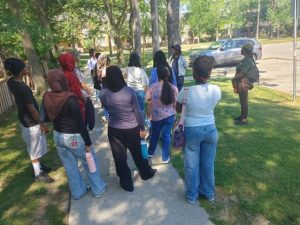
Image 1. YCF participants on a neighbourhood walk learning about the intersections between race, urban planning and climate injustice.
After this neighbourhood walk, our cohort brainstormed grassroots mechanisms the community has developed to respond to some of these material concerns. For example, the community has a vibrant community garden (pictured below) and food distribution system. Youth also note how mutual aid and advocacy channels are vital mechanisms used to support the material needs of vulnerable populations such as children and the elderly. Together, we identified how climate justice organizing around material needs are a foundational component of climate (de)coloniality and climate reparations (Sultana, 2022). As program developers and researchers, we hope to report these findings back to the City to advocate for and materialize better climate infrastructure in this neighbourhood.
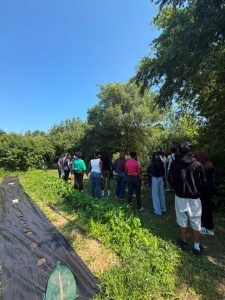
Image 2. YCF participants learning about the importance of community gardens and food sovereignty
Epistemic mode
The epistemic dimension of reparative education refers to how we are taught to think about ourselves and others, and which histories, languages, perspectives and worldviews we are taught to value and which we are directly or indirectly taught to ignore (Sriprakash, 2023). Epistemic hierarchies uphold global orders of racial domination, dispossession and denial of Indigenous sovereignty (Sriprakash, 2023). A reparative lens to climate education engages and resists these epistemic hierarchies to foster and expand different understandings of ethical climate relations. The implications of this dimension in the YCF program included integrating Black and Indigenous knowledge systems into the curriculum, and engaging BIPoC youth with histories and climate knowledges that come from cultural and geographic contexts they relate to. One way our program did this was though engaging in a guided canoe tour of the local Humber River where we learned about the importance of waterways. Marked as “the original highway”, the Humber served as a critical trade route for various Indigenous communities in the area. We also learned about local flora and fauna along the Humber, and the importance of environmental protections in these ecologically sensitive areas. Although subtle, these kinds of engagements forefront neglected histories of the land and hold significant potential in supporting anti-capitalist orientations to land which are necessary for participation in larger scale decolonial movements (i.e. Land Back).
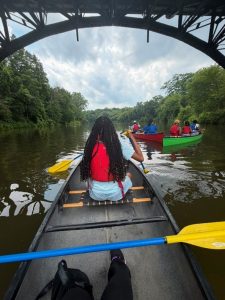
Image 3. YCF participants canoeing on the Humber River.
Our YCF cohort also spent considerable time discussing where participants’ families were from and what climate injustice looks like, globally. Youths’ families came from Somalia, Kenya, Jamaica, Saint Vincent, Angola, and India. All youth were able to share either firsthand experience or stories of family members having lived through some sort of climate disaster in recent memory such as a drought, excessive flooding, or hurricanes. Interestingly, all youth were able to identify that their families had connections to land or complex ecological knowledge back home; yet, none were able to identify how these knowledge systems were useful or relevant in Toronto. This speaks to major gaps in how we conceptualize what is considered valuable climate knowledge in Western education, recognizing that more needs to be done to meaningfully engage minoritized youth and their families with environmental knowledges from “back home”.
Relational mode
Finally, the relational dimension of reparative education refers to practices and processes that nurture ethical and repaired relations between one another, in the context of injustice. It can be thought of as praxis where new norms, relations and institutions can be made, a basis in which one can create with others new political possibilities (Sriprakash, 2023). In addition to nurturing ethical land relationships, a mentioned previously, YCF aimed to foster youth connection to a community of BIPoC climate role models and leaders. One of the persistent structural injustices in the climate sector is the lack of racialized representation and barriers to entry into the sector. By creating a supportive pedagogical community in which young people can see themselves pursue climate-related postsecondary and career pathways, we hoped YCF was where youth could feel connected and inspired to engage and contribute to climate decision-making spaces. In a landscape where BIPoC representation is urgently needed, this relational component is critical to help youth see what inclusive climate mobilizing looks like, in ways that nurture accountability and redress for the communities they come from. In our exit interviews with participants, many youth participants noted that this was the first time they saw BIPoC environmental leaders, noting they thought “environmental and outdoorsy stuff was for White people”. This speaks to histories of exclusion and dominant White imaginaries that have marked the outdoors as void of Indigenous presence and history (Curnow & Helferty, 2022; Ho & Chang, 2022). Others have written how outdoor environmental programs have typically disenfranchised Black communities and racialized newcomers, where public safety and racism have been significant concerns (Scott & Tenneti, 2021). Other youth in the YCF program noted that being in an exclusively BIPoC space meant that they didn’t have to explain themselves or their racial contexts, and that mentors and leaders “would just get it”. We see this relational dimension as an important characteristic in building safe environmental learning spaces where youth can explore how their histories, lived experiences and cultural knowledges are an essential part of impactful environmental learning and knowledge creation.
Conclusion
This brief snapshot of YCF program activities sheds light on the generative possibilities of applying a reparative lens to climate education. While youth participation is widely noted as a precondition for the success of climate action, youth from Indigenous, Black, and racialized communities remain grossly underrepresented in climate decision-making spaces in municipal, national and international levels (Narksompong & Limjirakan, 2015; UNDP, 2022). By theorizing what reparative climate education can look like through material, epistemic and relational principles, we hope more climate programs and learning engagements can forefront the needs of those most impacted by the climate crisis.
The YCF program was funded by the City of Toronto, a SSHRC Partnership Engage Grant, and a Research for Inclusive Excellence grant awarded by the University of Toronto Scarborough Office of the Vice-Principal Research & Innovation (OVPRI).
References
Curnow, J., & Helferty, A. (2022). Contradictions of Solidarity: Whiteness, Settler Coloniality, and the Mainstream Environmental Movement. In J. Dhillon (Ed.), Indigenous Resurgence: Decolonialization and Movements for Environmental Justice (pp. 147–166). Berghahn Books.
Ho, Y. C. J., & Chang, D. (2022). To whom does this place belong? Whiteness and diversity in outdoor recreation and education. Annals of Leisure Research, 25(5), 569–582.
Narksompong, J., & Limjirakan, S. (2015). Youth Participation in Climate Change for Sustainable Engagement. Review of European Community & International Environmental Law, 24(2), 171–181.
Scott, J. & Tenneti, A. (2021). Race and Nature in the City. Engaging Youth of Colour in Nature-Based Activities. Nature Canada. https://naturecanada.ca/wp-content/uploads/2021/04/Race-Nature-in-the-City-Report.pdf
Sriprakash, A. (2023). Reparations: theorising just futures of education. Discourse (Abingdon, England), 44(5), 782–795.
Sultana, F. (2022). The unbearable heaviness of climate coloniality. Political Geography, 99, 102638-.
UNDP. (2022). Aiming Higher Elevating Meaningful Youth Engagement for Climate Action.
Guest contributions to the Repair-Ed blog represent the perspectives of the authors.